Where Does the P5+1 Stand on the Iran Nuclear Deal? US President Donald J. Trump is expected to reveal his decision on May 8 as to whether he will extend key sanctions waivers on Iran. A failure to do so would effectively take the United States out of the Joint Comprehensive Plan of Action (JCPOA)—the Iran nuclear deal—which it signed with the United Kingdom, France, Germany, Russia, China, and Iran in 2015.
Posts
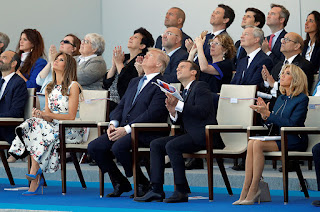
Donald Trump is Not the Only One Who Loves a Grand Parade US President Donald J. Trump wants a military parade — a big military parade. Trump, reportedly inspired by the Bastille Day parade he witnessed in Paris last summer, has asked the Pentagon to organize a parade down Pennsylvania Avenue in Washington that [wait for it] tops the French. US President Donald Trump and French President Emmanuel Macron attended the Bastille Day military parade in Paris with their wives, First Lady Melania Trump (left) and Brigitte Macron (right), on July 14, 2017. Trump was reportedly so impressed by the display that he asked the Pentagon to host a military parade in Washington. (Reuters/Yves Herman)
Macron’s Putin Policy: ‘Firmness Without Provocation’ French President Emmanuel Macron would like to work with Russian President Vladimir Putin in an effort to seek mutually acceptable solutions to crises that have bedeviled ties between the West and Russia over the past few years, France’s ambassador to the United States, Gérard Araud, said in an Atlantic Council phone briefing on June 19. Unlike the Soviet Union, Russia “is not an existential threat” to Europe, said Araud.
France Facing its Biggest Threat Since 1945 France, a victim of terrorist attacks for the past nineteen months, is facing its greatest security challenge since World War II, according to Gérard Araud, France’s ambassador to the United States. “It is a very, very dark moment for my country,” said Araud. “It is obviously the biggest threat that France really has been facing since 1945.” “It is a threat against our security, but it is also a threat against our values, the social fabric of our country,” he added.
Europe’s (In)security Challenge A spate of terrorist attacks across Europe over the past nineteen months has shaken confidence in European security, but has had divergent impacts on the popularity of the leaders of France and Germany, according to the Atlantic Council’s Fran Burwell. While German Chancellor Angela Merkel has seen a rise in support, French President François Hollande has found his already low approval ratings dip further.
A Roadmap for Europe The European Union’s unity is being tested in some significant ways. Chief among these challenges are the United Kingdom’s potential exit—a “Brexit”—from the EU, mediocre long-term economic prospects, an influx of migrants that is the largest movement of people on the continent since World War II, geopolitical threats posed by a revanchist Russia and a Middle East in the midst of upheaval, and the task of developing a digital roadmap that will support competitiveness and growth. Europe’s future hinges on how it addresses all these issues.
US Response to Migrant Crisis an ‘Existential Issue’ Americans need to repudiate the “deeply offensive” anti-migrant rhetoric coming from Republican presidential frontrunners Donald Trump and Ben Carson that runs contrary to the founding principles of the United States of America, said R. Nicholas Burns, a former Under Secretary of State for Political Affairs. Carson has compared migrants fleeing the war in Syria to dogs; Trump would support establishing a database to track Muslim Americans; Jeb Bush would prefer it if the United States took in Christian migrants ; and Ted Cruz is adamant that the United States should only accept Christian migrants . Republican Governors, meanwhile, have said they will refuse to let any Syrian migrants into their states. “I think Donald Trump and Ben Carson, in particular, have made statements that go beyond the pale and that should be rejected by the American people,” said Burns, who is the Roy and Barbara Goodman Family Professor of...
Turkey Shot Down a Russian Jet. Here's Why it Matters. The downing of a Russian SU-24 fighter jet by Turkey after it violated Turkish airspace and ignored ten warnings exemplifies the danger of Russian military support for Syria’s embattled President Bashar al-Assad. But it will also complicate French President François Hollande’s quest to include Moscow in a unified coalition against the Islamic State of Iraq and al-Sham (ISIS).
Will Europe Continue to Stand with the United States if Congress Rejects Iran Nuclear Deal? A steadfast alliance between United States and Europe—epitomized by a crippling sanctions regime—is widely credited with having brought Iran to the point where it was willing to consider curbs on its nuclear ambitions. But what would happen to that united front if Congress were to reject the deal reached between the so-called P5+1 and Iran in July? That’s a million-dollar question.
The Other Massacre While the world’s media has been focused on the terrorist attacks in Paris, Boko Haram, the deadliest militant group in Africa today, reportedly massacred more than 2,000 people in northeastern Nigeria. The massacre was carried out in Baga near the border with Chad, where the militants seized a key military base on January 3. Daniel Eyre, Nigeria researcher for Amnesty International, said the killings “could be Boko Haram’s deadliest act.” And yet news coverage in the Western media in the days after the massacre was dominated by the terrorist attacks in Paris where two brothers who trained with al Qaeda’s affiliate in Yemen attacked the offices of Charlie Hebdo, a satirical magazine, killing 12 people. A friend of the brothers’ who claimed ties to the Islamic State in Iraq and Syria (ISIS) in a separate attack killed five more people.
Will Belgian, French Violence Tilt Europe’s Balance of Security and Liberties? Today’s arrests and gun-battles in Belgium, as police intervened to prevent what they said were Islamist terrorist attacks in the making, underscore that last week’s Islamist violence in Paris may signal what Atlantic Council analyst Barry Pavel then called “a new normal.”
Yemen-Based Group’s Claim of Paris Attack May Boost Its Ability to Strike the West The claim by al Qaeda’s franchise in Yemen that it was behind the terrorist attacks in Paris last week, if true, would boost the group’s ability to plan similar attacks in the West, according to Atlantic Council analyst Barry Pavel. In a video posted on its Twitter account on Wednesday, Al Qaeda in the Arabian Peninsula (AQAP) said it carried out the attack on the offices of Charlie Hebdo in Paris to avenge the publication by the satirical magazine of cartoons of the prophet Muhammad. The group vowed even more attacks in the West.
The Killings in Paris: A Shocking ‘New Normal’ The killing by masked gunmen of at least a dozen journalists and others in Paris is an “unfortunate new normal” in an era marked by Islamist extremism's Generation 3.0—a strain more virulent than that of al Qaeda, according to the Atlantic Council’s Barry Pavel.
France Responds to Paris Attack by Stressing 'Fraternité' A restrained response by France's political mainstream to yesterday's killings in Paris—peaceful street vigils and the ringing of church bells—may reduce the risk of an anti-foreigner backlash, says Atlantic Council analyst Nicholas Dungan. That in turn will limit the assault's impact in strengthening radicals both on the far right and in the Islamist community.